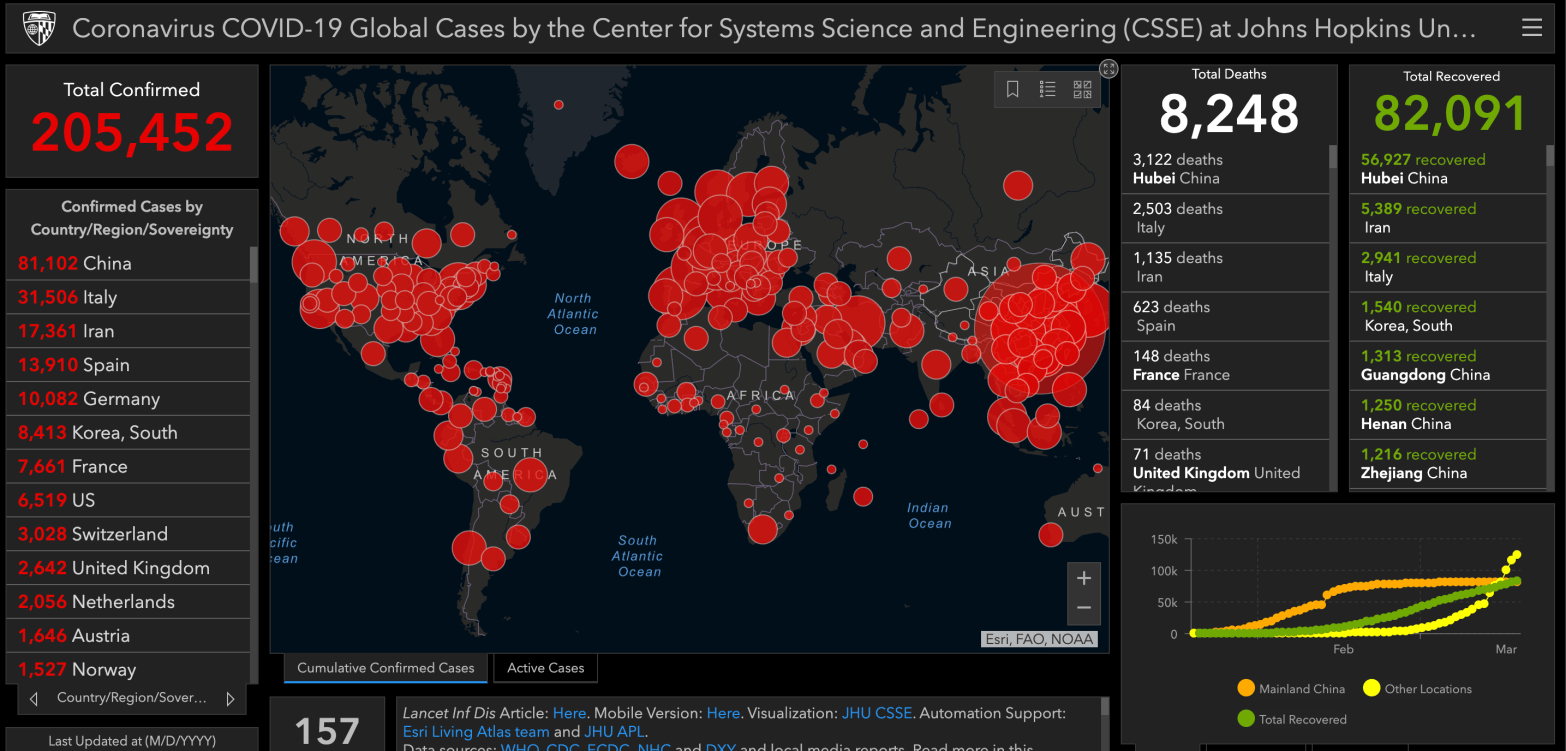
It feels like the world is on fire don’t you think?
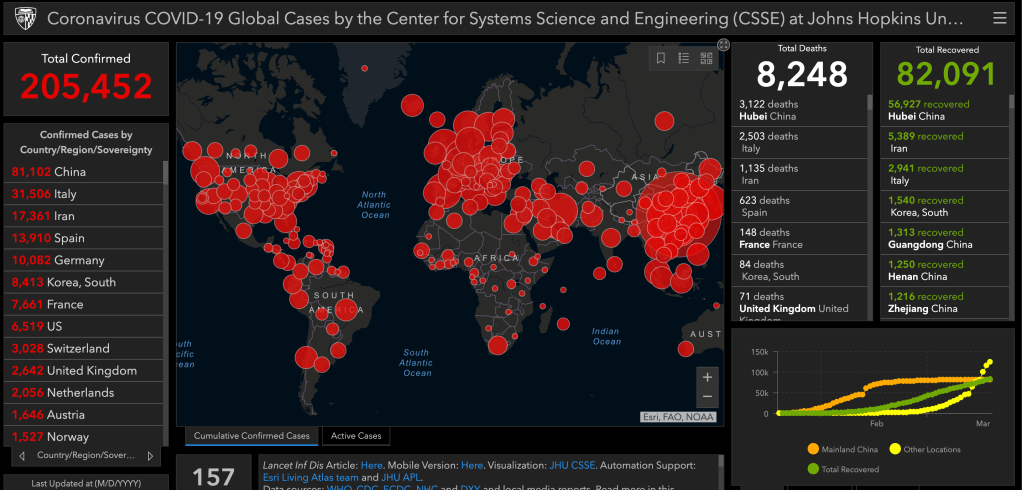
The current situation is unprecedented. No cliche. The walls of society have shown to be as thin as the prefab homes created in recent times where profit was valued over craftsmanship, longevity and quality. People have shown how fickle they are and Brits abroad have displayed the traits we’d rather forget. The situation has not been taken seriously enough in the very countries that are supposed to exemplify progress, control and organisation. The warning signs were evident, despite ‘hindsight being a wonderful thing’ we are guilty of not listening (and it isn’t so wonderful). As a privileged person I feel guilty that the world I come from did not listen to the advice of its own experts or research institutions. I am also annoyed that the reaction more than two months after the virus was first sequenced is not strong enough. The scientists are hard at work; searching for a cure/vaccine and treatments to defeat our common enemy but they cannot do it alone.
The response in China has been proven to be effective. On the 24th February the World Health Organisation (WHO) completed a joint paper:

The inputs to the report came from a number of experts in their fields, from all continents on Earth (bar Antartica):
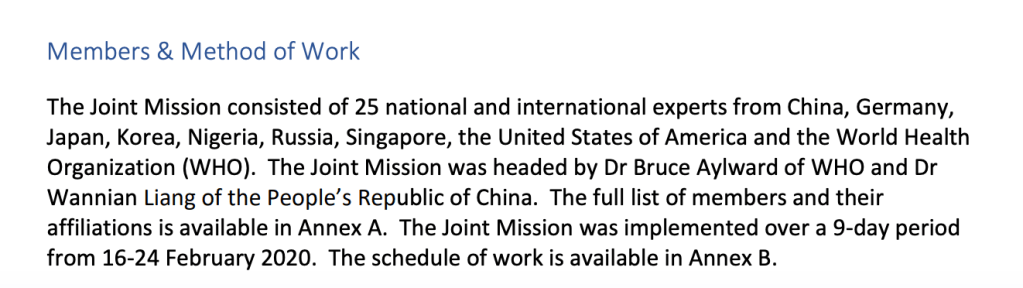
The most crucial piece of advice from the report, which was published online, free for all to read is as follows:
“Much of the global community is not yet ready, in mindset and materially, to implement the measures that have been employed to contain COVID-19 in China. These are the only measures that are currently proven to interrupt or minimize transmission chains in humans. Fundamental to these measures is extremely proactive surveillance to immediately detect cases, very rapid diagnosis and immediate case isolation, rigorous tracking and quarantine of close contacts, and an exceptionally high degree of population understanding and acceptance of these measures.
Achieving the high quality of implementation needed to be successful with such measures requires an unusual and unprecedented speed of decision-making by top leaders, operational thoroughness by public health systems, and engagement of society”
https://www.who.int/docs/default-source/coronaviruse/who-china-joint-mission-on-covid-19-final-report.pdf
This advice is not new, it’s been sat on the WHO website (at the link above) for all to read for more than half a month. Despite the above guidance from the organisation named WORLD HEALTH ORGANISATION, I feel that those in power and to an extent everybody else has decided to ignore their advice.
Please think about this when you decide to go out to the pub, for food, to visit an elderly relative. You can and do have a responsibility.
I’d also recommend reading academic papers from those on the frontline fighting the virus in Wuhan. The information contained in these documents are the things the news should be reporting on instead of how many people have queued for toilet roll or how the stock market is performing.
There are a number of reasons for the denial of fact. Humans innately dislike change; I’ve got a business degree and spent a large portion of my time reading the Harvard Business Review (HBR). Here’s an extract from a 2012 article:
Ten Reasons People Resist Change
- Loss of control
- Excess uncertainty
- Surprise, surprise!
- Everything seems different
- Loss of face
- Concerns about competence
- More work
- Ripple effects
- Past resentments
- Sometimes the threat is real
Do you recognise any of those feelings above? Yes? Good… you’re human then! Change is scary – but it’s not as scary as the killer virus that’s sweeping the planet. There will be a period of time when many of the above feel and are real to you (and I) but know that the consequence of inaction is worse than anything in the list above.
What we are currently experiencing will not be the last time we are subject to a disruptive event that has global health and economic consequences. We are the generation that must deal with the hangover from a period of economic expansion, greed and wastefulness. If you wonder how those three things relate to the current situation firstly watch this video that explains the origins of the current virus. That video should also help clear up any xenophobia you may have toward a country whose citizens make up about 18.5% of the total worlds population.
Next we must turn our attention to big business. You know how we’re told to have a ‘6 month emergency fund’ to cover expenses during an emergency? And you’ll know how hard it is to claim any sort of benefit should you fall on hard times? Well it turns out that the large airline companies don’t have any cash. No emergency fund I hear you say… why not? Well because they’ve spent most of their cash buying back their own shares to increase profit over the past ten years – see here. The difference between those big companies and individuals is twofold. First, the majority of large companies have the capability to build up a large reserve of cash as is evidenced by legislation introduced post 2007 financial crash which made it a requirement for banks to be ‘stress tested’ by regulating financial bodies. Hint- they’ve got enough cash now! This change was only brought about due to the collapse of many large financial institutions during the financial crisis who did not have enough reserve cash to service their mortgage exposures. It is a symptom of capitalism; legislation is required in order to make decisions which are not ‘profitable’ and that sort of makes sense. The sole purpose of a company (in capitalistic terms) is to maximise shareholder value. If you are in charge of a company that is your responsibility. Legislation allows for sensible decisions to be made in that type of environment. Secondly, large business will be bailed out. In certain respects this is sensible; many people depend on these organisations for employment, income and custom. That doesn’t mean it’s okay to willingly enter a compromised, risky position because you know the government will bail your business out. It’s also important to remember that when the government bails out a large organisation they aren’t doing it with magic money printed at the Mint, they’re doing it by using tax money/future bonds/YOUR MONEY to do so. Government safety nets do not extend to individual in this manner. Legislation introduced by a variety of parties also lead rise to an environment where it is impossible for the average citizen to save a ‘6 month emergency fund’. I’m not entirely sure where that leaves us. I don’t have an answer but I have a feeling that it’s not right or sustainable and it may even be dangerous.
We should all worry about the environment. The virus may be topical but we have the knowledge, technology and capabilities to fix it before it eradicates the entirety of the population. I’m not dismissing the current, urgent issue but I implore people to think about the evidence that has been presented to our generation since we first heard ‘reduce, reuse, recycle’ in our primary school classes. Scientists aren’t always right, that’s the nature of science, but on the climate issue there is consensus.
The cold war dominates memories of those living through the 60s-70s and 80s. Our generational wars are likely to revolve around water. Around 1/5 of the worlds population currently live in an area which, by 2100, is likely to become inhospitable. The rise of right-wing populism and extremism seen in the West in the past ten or so years as a result of ‘terrorism’ and civil war in the Middle East will be eclipsed in an instant if there are 1 billion people who must move from South Asia to survive. For comparison around 5 million people had to leave their homes during the Syrian civil war (with over 3 million ending up in Turkey, not Europe). Since then we’ve seen the rise of right-wing governments across the European Union, Trump has been elected president of the United States and Britain decided to leave the EU. I have no idea what happens if 200x that number of people need to go somewhere & I don’t think anyone has prepared that. At this stage it will return to a war of countries, not ‘ideals’. And this time around there are nuclear weapons involved.
Despite the tone of this post I’m not depressed or hopeless; I think if there is one good thing to come of this situation it is hopefully that people, governments and leaders realise that the status quo really does not exist. We are blessed with an average life expectancy of ~75-85 years and so 20 or 30 years feels like a relatively long period of time, it’s not. The 4 year election cycle aligns nicely with political soundbites and inaction but the damage done to the world does not adhere to the same timelines, nor does Mother Nature. If you’d like to get a sense of what I mean and how ‘our period’ of time e.g. 1700-now is so insignificant I’d suggest reading the great book ‘Sapiens: A Brief History of Humankind’ – it’ll make you think about how our world is currently and show the possibility that material changes have, and can, be made.
Despite all the negativity human resilience shines through. There are countless stories of; people offering help to their neighbours, offering to assist the elderly, singing from balconies, sharing tips and advice etc.
Nature has also shown her resilience:
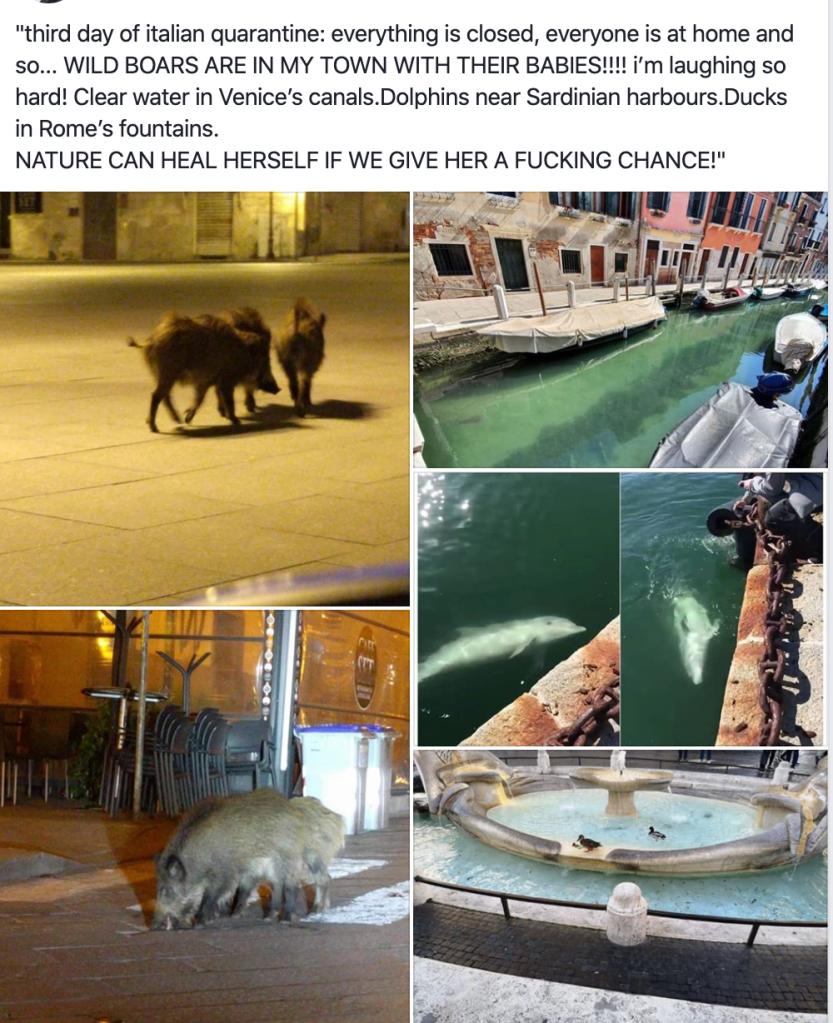
If there is one good thing to come of this horrible period I hope we take a look at what is important and make the required changes to get to where we want and need to be, as a planet.
We are blessed with technology and aided by globalisation and access to information. These things are however only tools. Much like our ancestors, our fate will be determined in how we put these tools to use. The tools alone do not guarantee a positive outcome, they only improve our chances if applied in the correct, collective manner to benefit all.
Inabit x
 Giraffe Gaffes